Field Exchange
The bureau, its people and an unusually persistent filing cabinet.
Field Exchange is an observation exchange and social network established in 1932. Its members discuss natural phenomena, trade paper positions, share hand-drawn charts and use the same forum for the ordinary business of being neighbours. The institution’s humour comes from treating fog, garden conditions and astronomical cycles with the administrative seriousness of a large financial exchange.
The old contract names still appear on the modern board: Fog Potential, Drying Power, Blossom Window and Mushroom Mood. In the early book, members bought or shorted expectations about visibility, laundry weather, late frost and foraging conditions. Today these have transparent index formulas and the same CR quotation.
The present exchange combines a working CR trading terminal, natural-world research and the bureau’s illustrated archive.
Contents
Origins
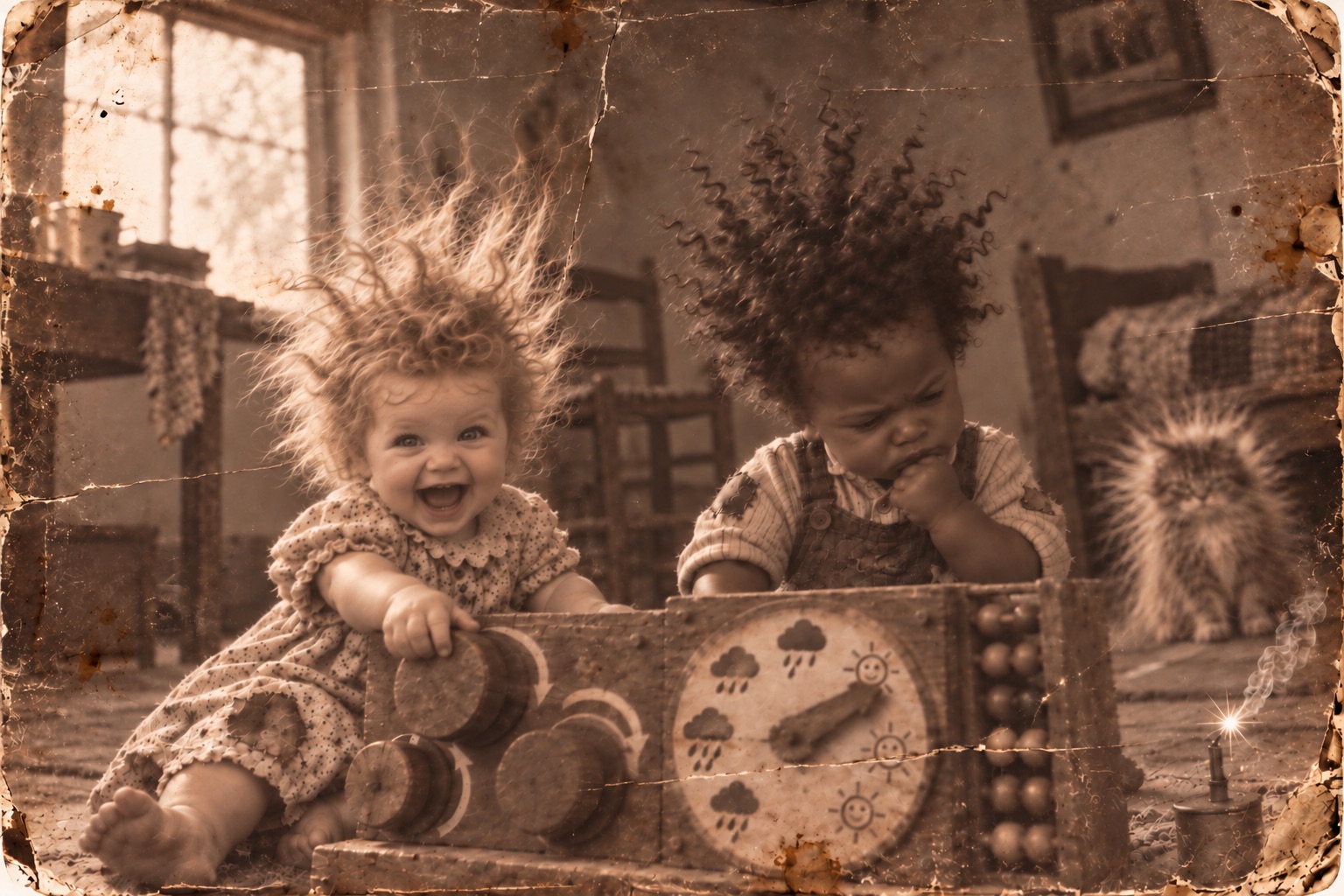
The recurring founders are Ida and Emil, both born in 1902. They meet as small children, grow up repairing salvaged equipment, open the garage bureau at thirty, and remain friends into old age. They come from ordinary households, borrowing space and repairing discarded parts. No inherited fortune explains the bureau. Their story follows one pair of people rather than replacing them with unrelated faces in each era.
The exchange begins in a borrowed garage shared by a radio repairer, a bookkeeper and a gardener. Their first project is a common observation ledger: one person records the reading, another checks the arithmetic, and a third asks why the units have disappeared again. The network connection is taken for granted, while the borrowed ruler is carefully inventoried.
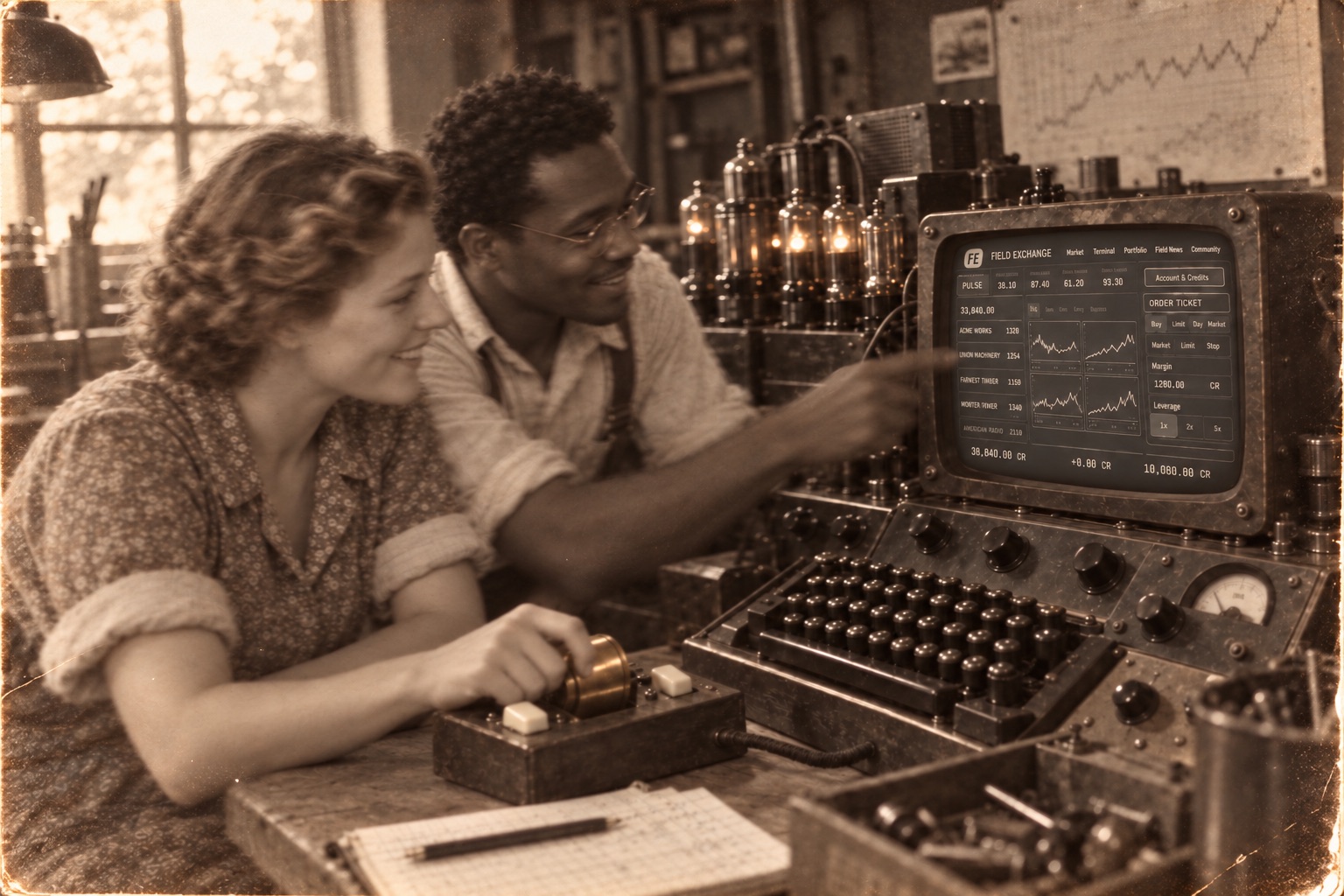
The garage becomes a meeting place because it is warm enough to sit in and has a table large enough for several notebooks. Members bring radios, weather sketches and household questions. Paper-credit trading is introduced as a way to compare expectations without turning every disagreement into a speech. The founding rule is remembered as “one witness for arithmetic, none for opinions”—a line from the bureau’s charter.
The research has a long view too: the GFZ planetary magnetic-index archive contains records beginning in 1932.[1] The currently published early bureau sheets aggregate complete monthly records from 1940 onward; earlier community material can be added later.
The common town square
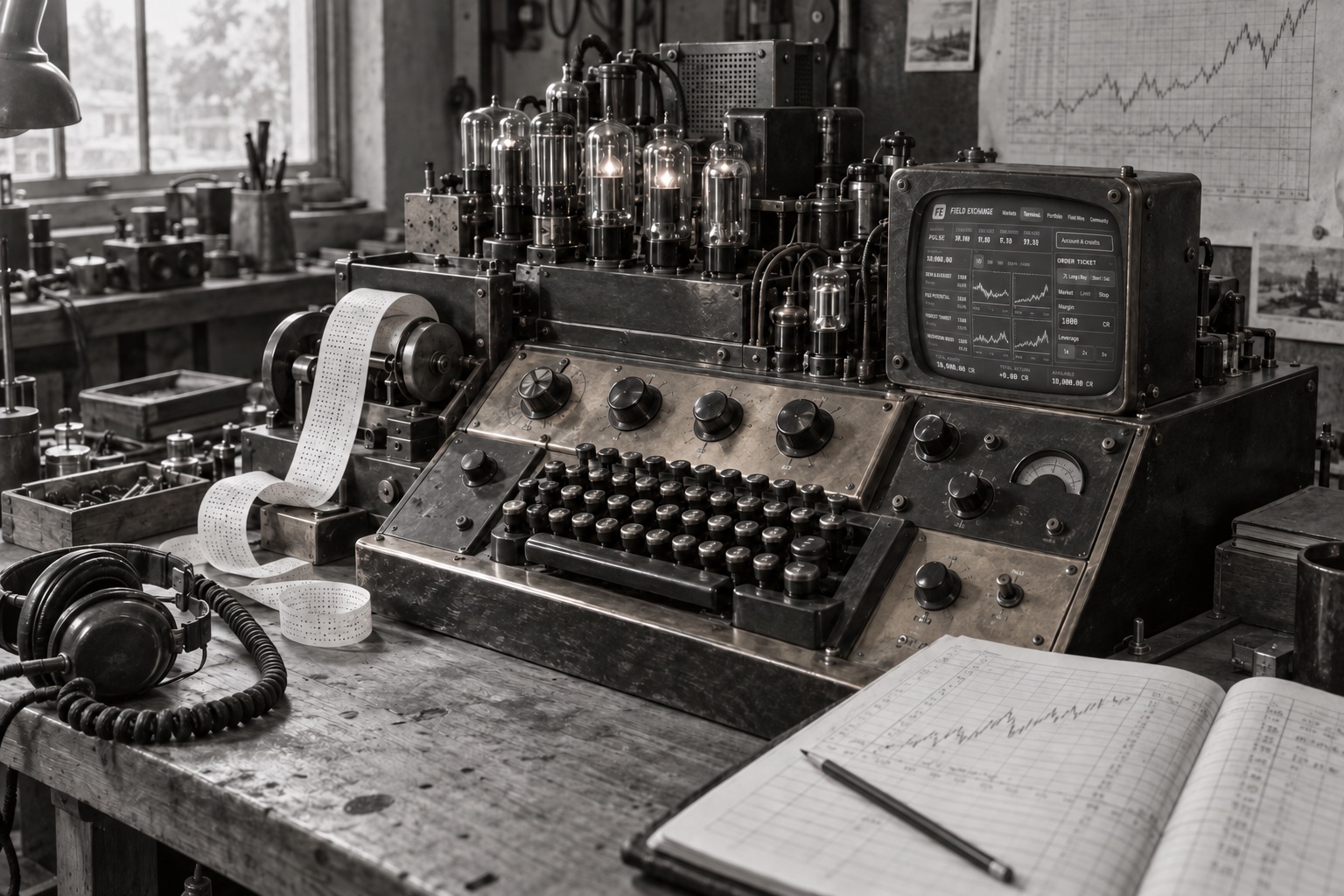
The early exchange becomes the neighbourhood’s principal social network. The market column sits beside film discussions, music links, repair requests, recipes and messages from family members. A “screenshot” may be a photograph of a ruler-and-ink chart, uploaded as casually as a modern phone capture. The online gramophone becomes an essential department.
Members discuss real works that belong to their period, including The Wizard of Oz (1939) and Casablanca (1942).[2][3] Replies concentrate on what someone noticed, who came to supper and whether the ending should have been hidden.
Real scientific events also enter the forum. A thread about Sputnik’s launch on 4 October 1957 puts the radio in the kitchen and leaves the soup to cool.[4] The archive later discusses weather satellites, lunar exploration and images of Earth. Each dated event carries its own reference.
From the garage to the glacier annex
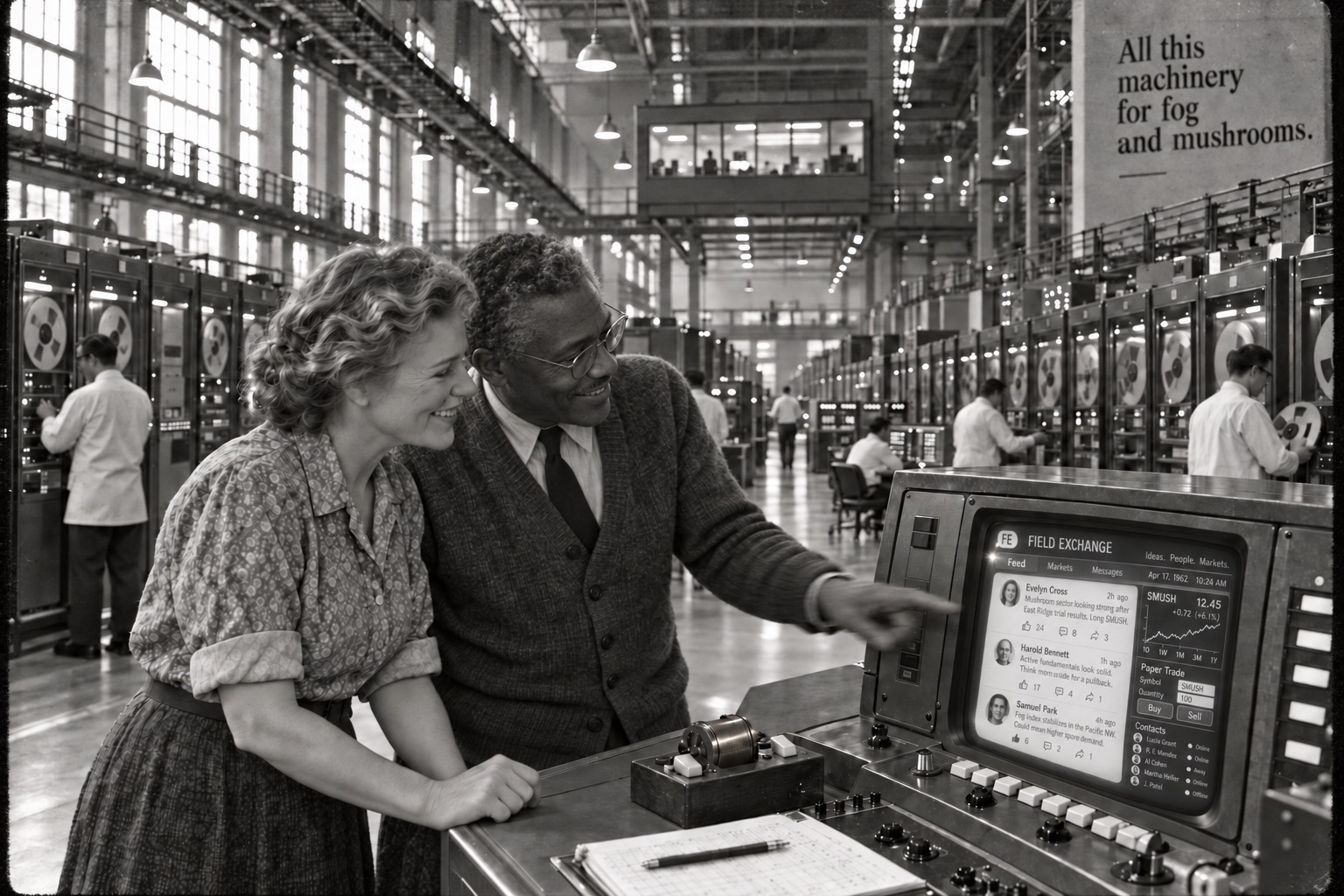
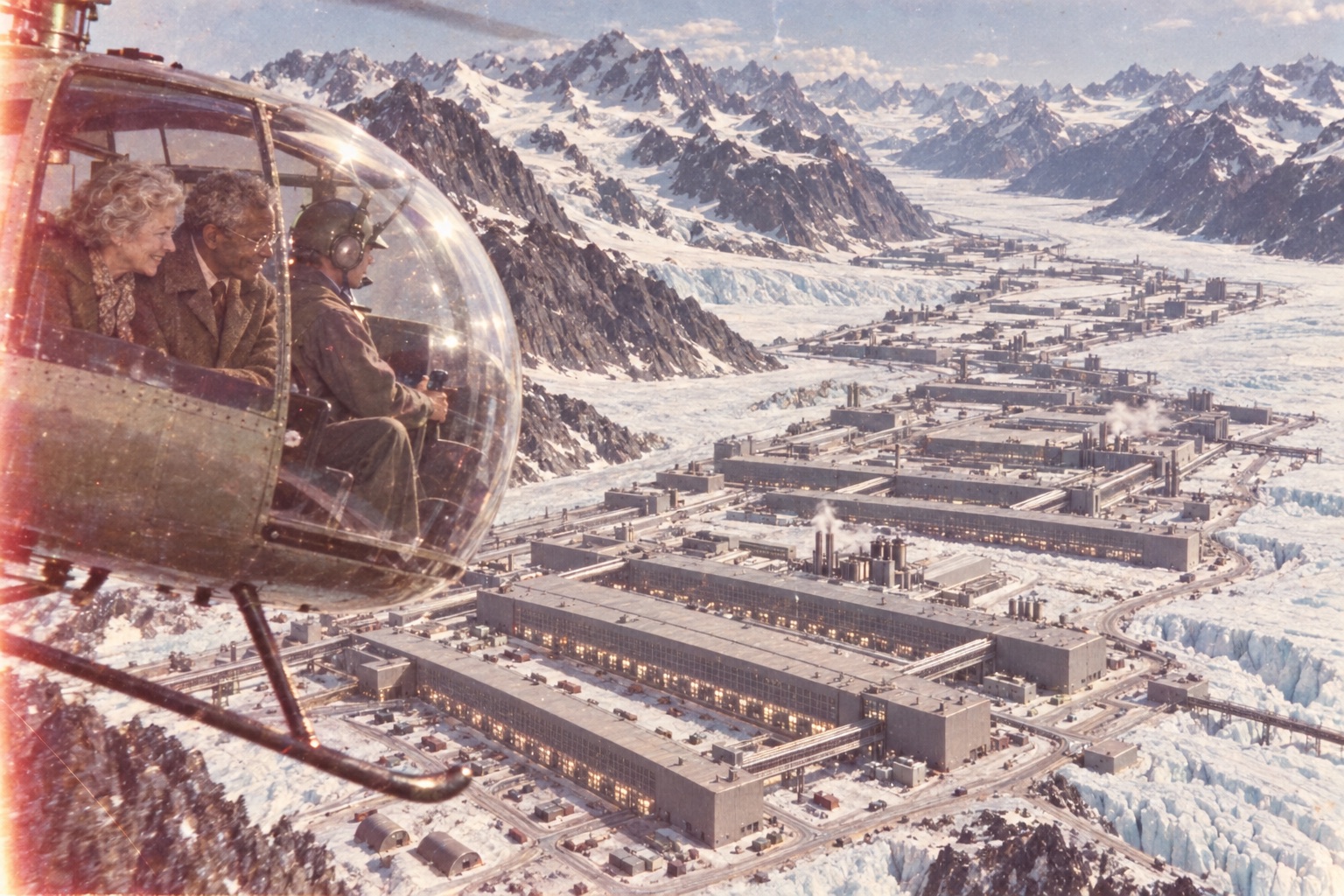
The halls belong to the growing cooperative, not to a wealthy family. The institution’s most extravagant chapter is the glacier annex: an enormous campus whose processing halls extend across an alpine valley. By the late 1970s the garage enthusiasts are elderly visitors, watching from a helicopter as younger engineers operate the machines. The bureau has become much larger than either founder expected. The original brass controller is still kept at the inspection desk.
All this computation leaves the forum arguing about whether the washing will dry by Thursday. A founder is said to have asked why the filing cabinet needed a helicopter; nobody could produce the relevant form.
The disputed guestbook
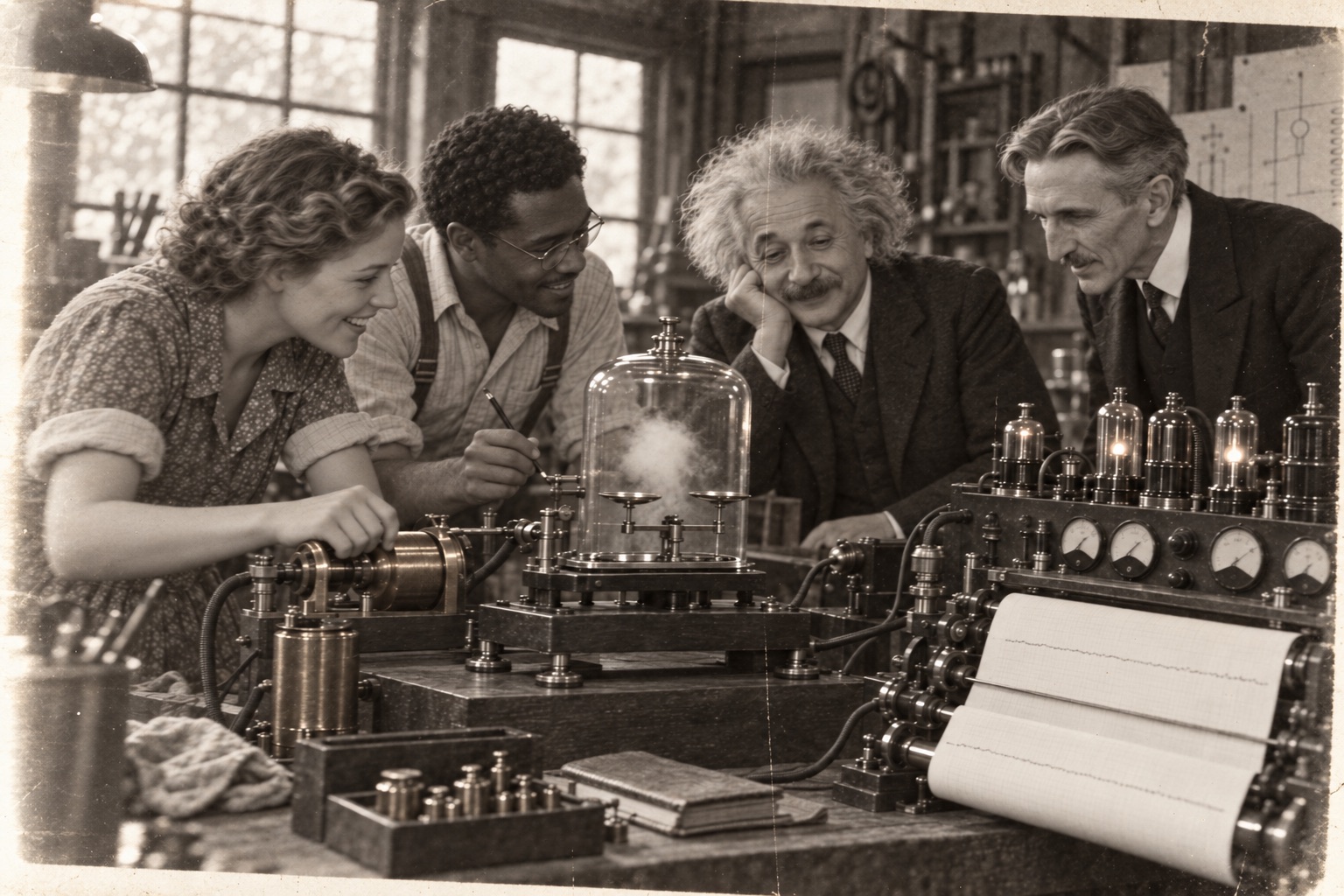
The founders are obscure even inside their own legend. They mend receivers, carry notebooks and somehow occupy the right borrowed room when an important visitor passes through. The guestbook describes Einstein and Tesla inspecting a machine that weighs fog. Its paper recorder draws almost nothing; the founders insist that this is an unusually stable session.
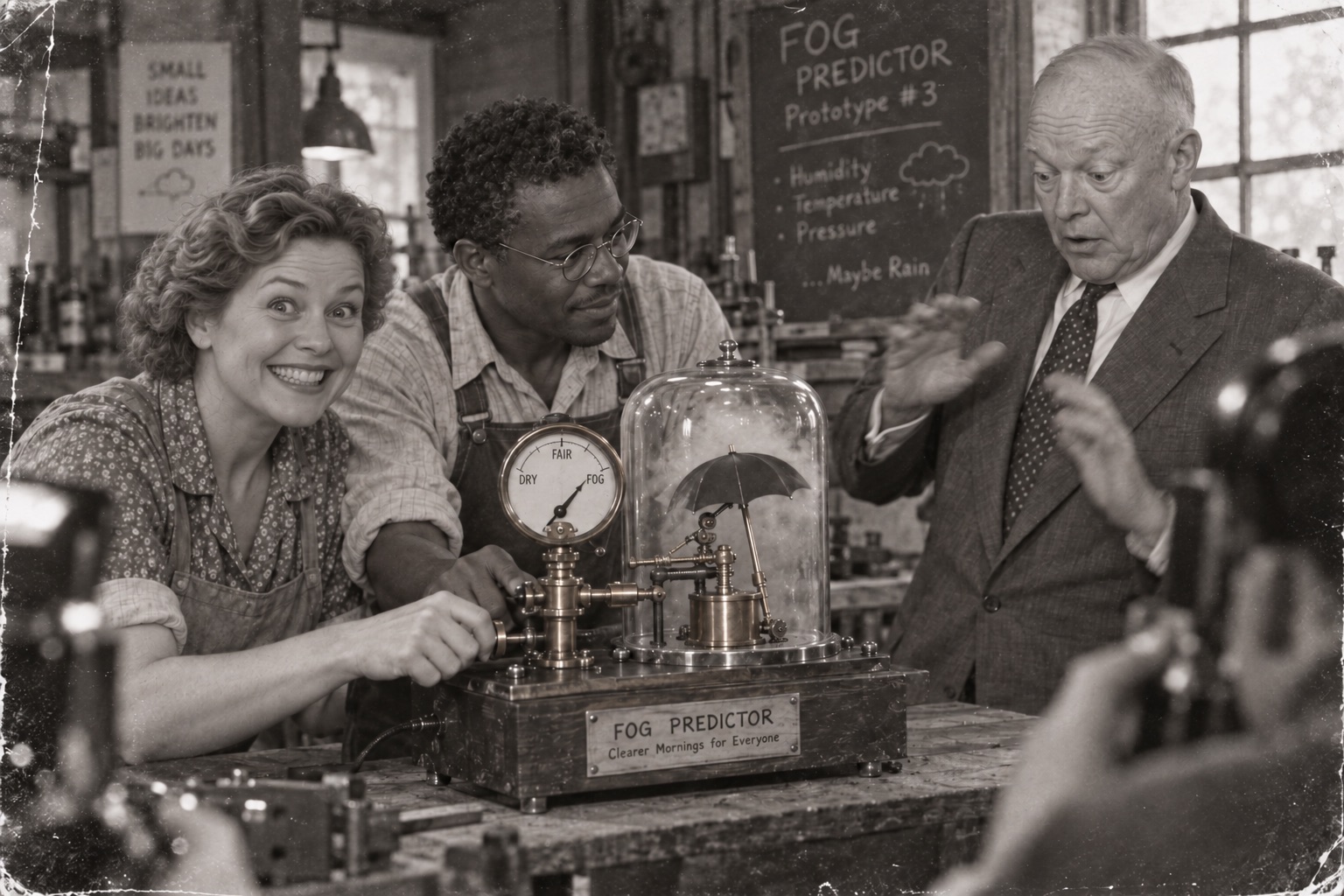
The guestbook also records a presidential inspection. Eisenhower leans toward a fog prototype just as its little umbrella opens without warning. The most powerful visitor in the room briefly gives the machine more space; Ida checks the gauge.
No reliable account explains how the visit was arranged. One member remembers a repaired doorbell; another believes the visitors were looking for the next building. The bureau keeps the disagreement beside the photograph.
The founders disappear
One later forum story describes Ida and Emil at about ninety-five, dressed in ordinary coats, explaining their portable fog desk to a patient man on a park bench. The forum identifies him as Forrest Gump. This solves none of the filing department’s problems.
In 1998 both founders stop posting. There is no final announcement, verified destination or agreed explanation. Theories persist: a quiet retirement without passwords; a return to the borrowed garage; a glacier service corridor whose exit was never indexed; or an account migration that worked rather too well. The librarian asks members to separate a memory from a sighting. Nobody declares a death from a missed login.
Later threads remember two unimportant-looking people who were occasionally in extraordinary company. Their apparatus is still recognised; their private lives remain mostly unknown. A recurring note under the old screenshots reads: “If you find the founders, please ask whether this cable is theirs.” The mystery stays open.
Members and their lives
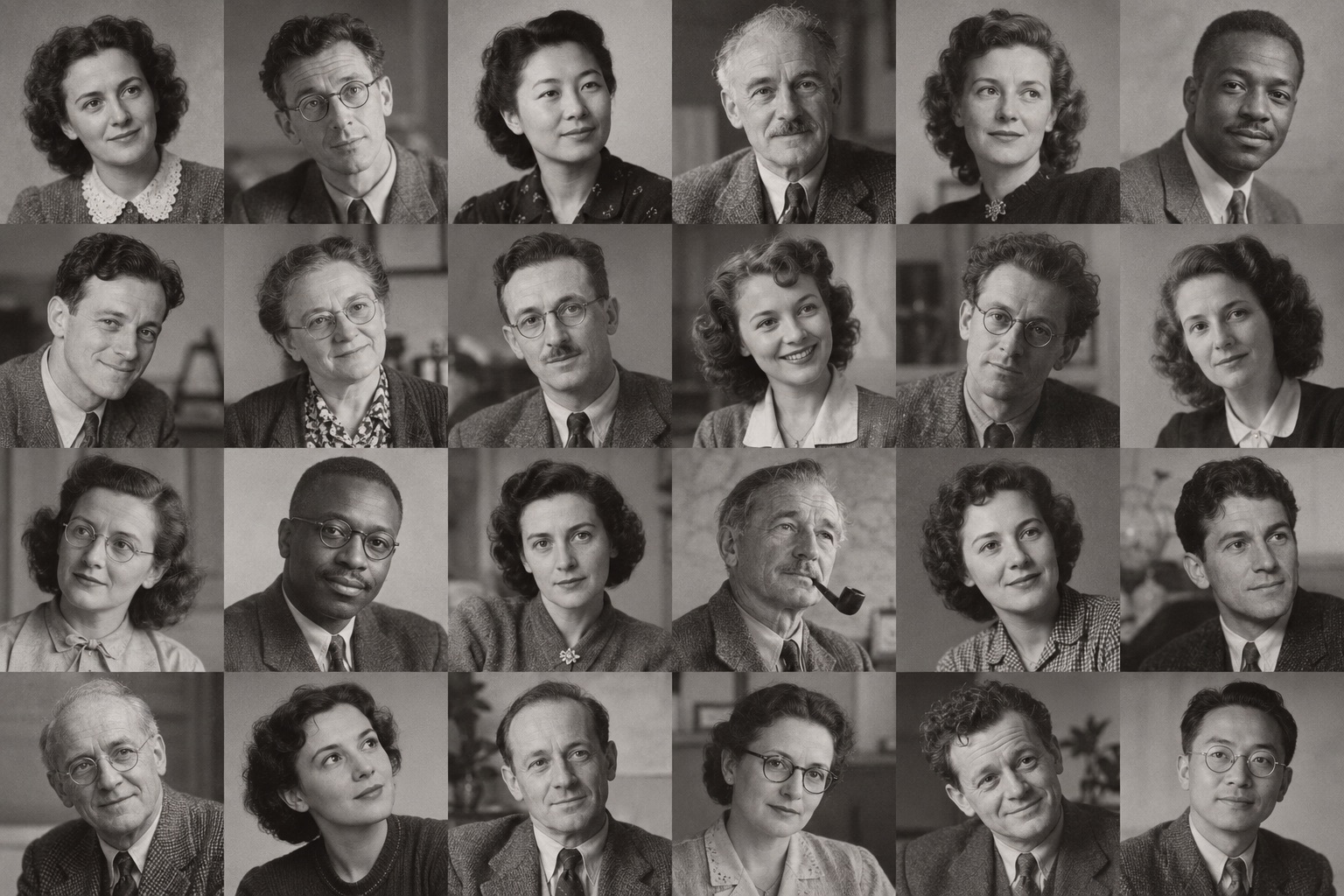
The cast includes radio listeners, printers, librarians, railway clerks, gardeners and teachers. Profiles have joining years, lifespans, occupations and small habits. A character may lend a receiver, move house, help an ageing parent or hand the evening desk to an apprentice. Posts survive their authors; later members continue conversations and remember people who have died.
The address book contains 2,400 archive characters. Short biographies provide a broad cast; a smaller number of authored story arcs supplies the recurring relationships and significant events. These arcs include a borrowed ruler, a father-and-son radio project, a bookshop, a shared allotment and a night librarian’s care for a parent.
Remembrance notices use quiet language. They preserve the departed member’s notes and introduce the successor without treating death as a trading signal. New members inherit a desk rather than a guaranteed talent.
The celebrated notebooks
The archive occasionally gives a trader an extraordinary two- or three-year run: the paper book appears to catch every top and bottom. These characters become forum legends precisely because the run is temporary. Later threads remember the perfect timing, but also the lent pencils, patient explanations and evenings spent away from the chart.
One story concerns a paper short in gold during the turn of the 1980s. Its historical background is a Federal Reserve paper reporting that gold briefly reached $850 an ounce in January 1980 and was below $400 by July 1981.[5]
The notebooks include mistakes and ordinary years alongside the remarkable passage; recollections often value the conversation more than the forecasts.
Observation and reconstruction
Research desks use identified public weather and space-weather inputs. NASA POWER supplies daily regional meteorological observations; GFZ supplies planetary magnetic records; NOAA and NASA catalogues supply solar observations.[6] The published 25-index reconstruction begins in January 1984 and includes monthly points for four regional reference grids.
The formulas turn those inputs into interpretable indices. They are not direct measurements of a literal mushroom mood or a forest’s opinion. Derived values, documented estimates and missing data are shown separately. Monthly sheets require complete inputs; missing segments stay blank. The early sunspot proxy is identified as an estimate.
Historical observations retain their dates, source links and method versions. Research updates can add future complete months. NASA photographs retain their original credits; the image register records the provenance of the bureau collection.
The modern exchange
The current exchange quotes its natural-world indices against CR game credits. Desktop and mobile addresses share accounts and the underlying market. The desktop terminal supports four charts together, moving averages, RSI, orders and position management. Game prices combine shared simulation with research-derived anchors; a six-second screen refresh does not imply a new physical observation every six seconds.
The quoted market has zero spread. A separate 0.05 percent fee applies to entry and exit exposure in CR. These are paper positions and game credits.
A research event can produce a small, forward-only synthetic sentiment effect after the publisher submits eligible source evidence. Such effects are bounded, deduplicated and expire. A quiet day is permitted to remain quiet; a breaking-news label is not manufactured simply to make the screen move.
Culture and the Goods Bureau
The bureau’s visual culture moves from paper clippings and pictograms through typewriter-like columns to later electronic layouts. Its recurrent motifs are umbrellas, rulers, kettles and a filing cabinet that appears to have outlived several management systems. The modern terminal remains compact and contemporary.
The Goods Bureau publishes original comic advertisements for everyday things: milk, onions, umbrellas and other objects that seem mildly surprised to require advertising. These house notices can alternate with properly identified commercial placements. Sponsorship does not supply scientific readings or determine the direction of an index.
Institutional confidence is the central joke. Members argue over decimals, but the warmer stories are about lending things, meeting after work, listening to music and making room for newcomers. The exchange survives because it remains useful company, not because every participant is a genius.
References and image notes
- GFZ: definitive Kp and derived indices. Magnetic records and aggregation provenance.
- Library of Congress: The Wizard of Oz (1939).
- Library of Congress: Casablanca (1942).
- NASA: Dawn of the Space Age.
- Federal Reserve, International Finance Discussion Paper 190 (1981). Historical gold-price background only.
- NASA POWER: daily API documentation. See the historical sheets for individual source hashes and methods.
Source photographs carry their original credits. The image register records artwork origins, generation methods and file hashes.